 Reader Pick
Two Grape Chewables a Day With an Extract at Exactly the Dose of Its Two Trials, a Day's Vitamin B6 and B12, and Four Grams of Sugar: The Only Bottle on This Desk Whose Number Matches the Study, and the Small Print Around That Match
Brain Fuel is a twenty-dollar bottle of sixty soft grape chewables from Nature's Way of Green Bay, Wisconsin: 250 milligrams of a standardized grape extract sold under the Cognigrape name, a full day's vitamin B6 and B12, and four grams of added sugar, per two chewables. I read the two twelve-week trials of that extract in healthy older adults at that exact dose, read who signed them, read the twenty-four reviews and found that twenty-three were written by people who got the bottle for nothing, and read a forty-five-day satisfaction promise that covers the pharmacy shelf too.

This is a paid advertisement. Sponsored by Nature's Way Brands, LLC.
Clifford Penhale is the pen name of this desk.
The customers quoted on this page are real; their reviews are public on the seller's product page and were read there on September 9, 2026, and three of the four were written by people who received the bottle at no cost, which is marked beside each.
I haven't met them and know nothing about them beyond what they wrote.
The small photos beside their reviews are illustrations, not the reviewers.
Everything about the bottle, from the four lines on the panel to the forty-five-day promise, comes from the seller's own label and pages, read the same day.
I've read a lot of supplement labels at this table, and the dose on the label almost never matches the dose in the study the label is leaning on.
Half, a quarter, a tenth, a pinch in a blend: that's the usual arithmetic, and I've written it out a dozen times.
This bottle is the exception, and I want to say so before I say anything else.
Two of these chewables hold 250 milligrams of a grape extract, and 250 milligrams a day is exactly what the two trials of that extract gave to healthy older adults for twelve weeks. [1] [2]
The number on the label is the number in the trial.
So this page is about the small print around a match, which is a different kind of page: who signed the trials, what the vitamins beside the extract are worth, what four grams of sugar are doing in a bottle sold for the brain, why twenty-three of twenty-four reviews are from one month, and what the forty-five-day promise actually covers.
None of that undoes the match, and all of it belongs beside it.
Two chewables a day, by the label. Every number on this page is for those two chewables.
Here's what the bottle is.
Brain Fuel, from Nature's Way, a Green Bay, Wisconsin company whose vitamins have been on pharmacy shelves for decades, with a street address, a toll-free number and an email on its pages.
An amber bottle with a gold cap and a red-and-white label with a bunch of grapes on it, holding sixty soft chewables, which at two a day is thirty days.
The label calls them by a word this page won't print, because our advertising rules don't allow it; they're soft fruit chews set with pectin, no gelatin, and I'll call them chewables.
The panel, in the seller's order: calories, carbohydrate, sugars, vitamin B6, vitamin B12, sodium, and the grape extract at 250 milligrams.
Then glucose syrup, cane sugar, water, pectin, citric acid, flavorings, sodium citrate, sunflower lecithin and beeswax.
I did what I always do.
I read the label before the listing.
I read the two trials of the extract, at the dose and for the weeks they actually ran, and I read the author lists at the top of each.
I read the vitamins against the government's Daily Values and the largest review of B vitamins in older adults.
I read the twenty-four reviews and the small note under them.
And I read the promise page, which is better than most, and the shipping page, which charges for a single bottle.
What I found is a real extract at its real trial dose, two trials with the extract's maker on the byline, two vitamins that matter only if you're short of them, a teaspoon of sugar a day, a review page seeded in a single June, and a promise that holds up if you keep the receipt.
One more thing before the first hour, because most of you got here from one of our own advertisements.
Those ads talk about a boxed cereal, three foods, three drinks, and three words or phrases a man is supposed to be able to say.
None of that is in the chewable, and I won't pretend it is.
It's on this page, in its place: the cereal, the drinks and the word test are the seventh hour, and the honest version of every headline we run is in the guide linked at the foot.
Hour one · The bottleAn Amber Bottle, Sixty Soft Chews, and a Panel With Four Lines and a Sugar Line
This is what's on the table.
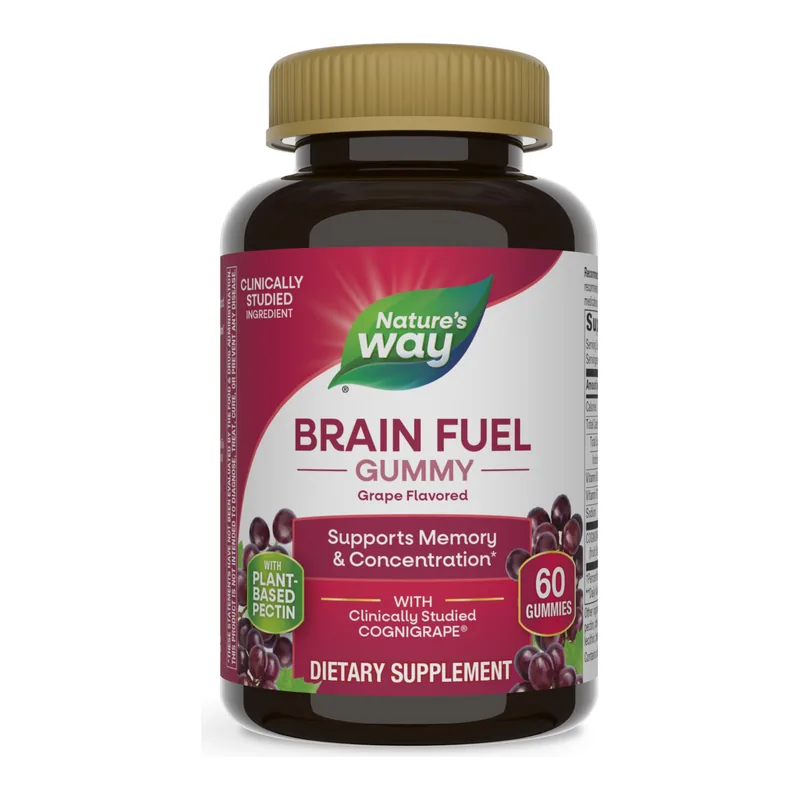
An amber plastic bottle with a gold cap, a red-and-white label, a bunch of purple grapes drawn on the front, and the words Brain Fuel, grape flavored, "supports memory and concentration" with the asterisk every supplement carries, and a line naming the Cognigrape extract as studied.
The side of the label says "with plant-based pectin," which is the thing that sets the chew.
The back is the panel, and I'll read it to you in the seller's order, per two chewables:
Calories, 25.
Total carbohydrate, 6 grams; total sugars, 4 grams, of which 4 grams are added sugars, 8 percent of a day's worth.
Vitamin B6, as pyridoxine hydrochloride, 1.7 milligrams, 100 percent of the Daily Value.
Vitamin B12, as cyanocobalamin, 2.4 micrograms, 100 percent.
Sodium, 15 milligrams.
Cognigrape grape fruit extract, 250 milligrams, no Daily Value established.
Other ingredients: glucose syrup, cane sugar, purified water, pectin, citric acid, flavorings, sodium citrate, sunflower lecithin, beeswax.
The label says the chews contain no gluten, wheat, soy, egg, peanut, dairy, gelatin or artificial colors.
The directions: adults chew two daily, do not exceed the recommended dose.
One extract, two vitamins, a teaspoon of sugar, and a chew set with fruit pectin.
The extract is the reason for the bottle, and it gets the next hour; the sugar gets one of its own.

Hour two · The extractTwo Hundred and Fifty Milligrams, Two Twelve-Week Trials at Two Hundred and Fifty Milligrams, and the Byline on Both
The line the bottle stands on, and the one where I have to say something I rarely get to say.
Cognigrape is a dried extract of red grape juice, standardized for its grape polyphenols and sold to supplement makers by an Italian company.
It has two trials in healthy older adults, and both used 250 milligrams a day, which is what two of these chewables hold.
In the first, 111 healthy older adults took 250 milligrams a day or a placebo for twelve weeks, and the extract group scored higher on a standard mental-status test and on a neuropsychological battery, including attention, language, and immediate and delayed memory; scores on visual-spatial tasks didn't change. [1]
In the second, 96 healthy older adults took the same 250 milligrams for 84 days, and the extract group again scored better on a mental-status test and on neuropsychological batteries, with a change on a selective-attention test reported within ninety minutes of the first dose. [2]
Two trials, 207 people, twelve weeks each, at this dose, in people my age, with results on memory and attention tests.
That's more than any other bottle on this desk this year can say, and I want it written plainly before the qualifiers.
Two trials, one maker on the byline.
Now the qualifiers, because they're real.
Both trials list authors from the company that makes and sells the extract, two of them on the first and one on the second, alongside university and contract-research authors. [1] [2]
That doesn't make the trials wrong, and it's common in this business, but it means the people with the most to gain helped design, run or write up the studies that support their product, and no independent group has repeated them yet.
The trials are also modest in size, 111 and 96, and a mental-status test is a blunt instrument in healthy people.
So the honest sentence is this: the dose matches, the trials exist, they were twelve weeks in people my age, and the extract's maker helped write them.
Hold all four parts, and buy or don't on all four.
An extract at the exact dose of its two twelve-week trials in 207 healthy older adults, both with the maker on the byline and neither repeated independently. The best-matched line on this desk this year, with its asterisk.
Hour three · The vitaminsA Day's Vitamin B6 and a Day's Vitamin B12, Worth Something Only to a Man Who's Short of Them
The two lines beside the extract, and the ones the label prints in the largest percentages.
Vitamin B6 at 1.7 milligrams and vitamin B12 at 2.4 micrograms are each exactly 100 percent of the Daily Value, which is the amount a label is allowed to call a full day. [3]
Neither is a large dose; a multivitamin prints the same or more, and so does a bowl of fortified cereal.
What do B vitamins do for the thinking of a healthy older man?
The largest answer is a 2018 Cochrane review of fourteen trials in 27,882 adults without memory trouble, which concluded that B-vitamin supplements, folic acid, B12, B6 and combinations, probably have little or no effect on overall thinking scores at any point up to five years. [4]
That review is about people who weren't short of the vitamins to begin with, and that's the important qualifier.
B12 is the one vitamin a clinician is likely to check in a man my age, because the body absorbs it less well with the years, and if a blood test says you're short, 2.4 micrograms in a chew is a small answer to a question the test asked.
A day's B6 and B12 for a man who isn't short of them is a day's B6 and B12, and the big review says it moves nothing.
For a man who is short, it's a start, and the blood test comes first.
Two vitamins at 100 percent of the Daily Value, which the largest review found does little or nothing for the thinking of people who aren't short of them. Real nutrients, small amounts, and a blood test decides whether they matter to you.
Hour four · The sugarFour Grams of Added Sugar in Every Serving, Which Is a Teaspoon a Day in the Name of the Brain
The line most people skip on a bottle sold for the mind, and the one I'd think about longest.
A soft fruit chew has to be made of something, and this one is made of glucose syrup and cane sugar set with pectin, which is why the panel shows 25 calories and 4 grams of added sugar per two chews.
Four grams is a level teaspoon, and 8 percent of the day's added sugar the label's own arithmetic allows.
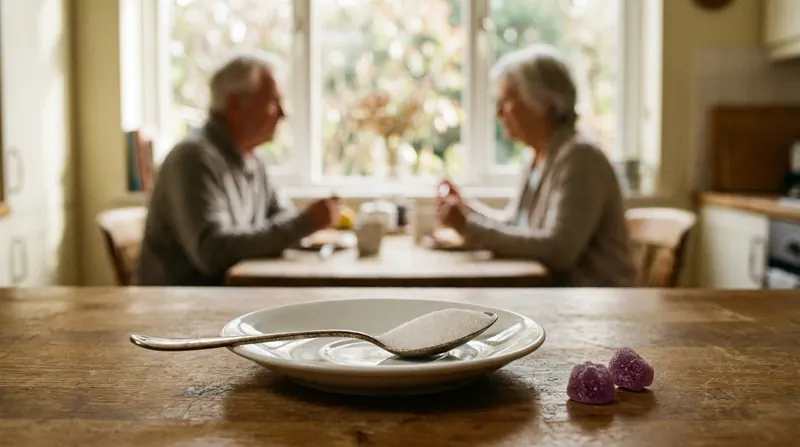
A teaspoon isn't much.
It's a spoon in your coffee, and nobody's health turns on it.
A teaspoon of sugar a day, in the name of the brain.
But it's worth naming on a page about memory, because the one thing the diet research agrees on, as you'll read in hour seven, is that added sugar in drinks runs the wrong way on memory tests, [5] and a bottle that asks you to eat a teaspoon of it every morning for the brain is a bottle with a small contradiction built in.
Not a large one, and not a reason to refuse the extract; a reason to know what you're chewing, and to brush your teeth.
If you'd rather not, the extract itself is sold in other forms by other makers, and this page doesn't rate them.
If you don't mind, a teaspoon is a teaspoon, and now you've counted it.
Four grams of added sugar, a level teaspoon, in every two chews, in a bottle sold for the mind. A small contradiction, counted.
Hour five · The word on the labelWhat the Bottle Calls These, What This Page Calls Them, and Why
A short hour, and a fair one.
The bottle uses a word for these chews that you know, that every candy aisle knows, and that our advertising rules don't allow on a page about a supplement, because the same word sells a great many things that aren't supplements.
So I've called them chewables and soft fruit chews, which is what they are: pectin, fruit sugar, flavoring, and the extract, set into a soft chew about the size of a thumbnail.
I'm telling you this so that when the bottle arrives and says a different word on the front, you don't think you've been sent the wrong thing.
You haven't; you've been sent a chew this page had to describe rather than name.
The bottle says one word, this page says "chewable," and they're the same soft fruit chew. Nothing else about the product changes.
Hour six · The reviewsTwenty-Four Reviews, Twenty-Three From One June, and the One From Last Year
The seller's page shows twenty-four reviews with an average just short of five stars, and under them a note in small type that the summary includes incentivized reviews.
I read all twenty-four, and the note is doing a lot of work.
Twenty-three of the twenty-four were posted in the first four weeks of June 2023, each marked in the review system as written by someone who received the product for the purpose, and each marked as a confirmed buyer all the same.
The twenty-fourth was posted in February 2025 by a customer with no such mark, who says she bought seven more bottles.
That's not a scandal; companies seed reviews when a product launches, and the seller discloses it.
It does mean that "twenty-four reviews, nearly five stars" is really one launch month and one customer, and you should read the four below knowing which is which.
I kept the one organic review and three of the seeded ones, and the seeded three are marked as paid beside their names, because a bottle at no cost is a payment.
I threw out the eighteen that use the word from hour five, two that use a phrase for a cloudy head our rules don't allow, and one that promises "long-lasting energy," which the panel doesn't.
These are real customers, quoted word for word from the seller's product page; the small photos beside them are illustrations, not the reviewers.

I would give this 10 Stars because it is helping to concentrate all day at work and I bought 7 more bottles. I take 2 when I wake up in the morning and I also love the flavor.

I started feeling a difference after only a few days of taking Brain Fuel. My head feels clear and I'm just able to focus better on the tasks I need to do.

Love these. They taste great and are a easy way to take your supplements

I've been enjoying taking these every day to support my brain function and mental performance. They're delicious, easy to chew, and are good for memory. In my job, I have to remember a LOT of things in my day to day so I'm glad to have something to support my brain!
Read those the way I did.
Maria is the one customer on the page who paid for her bottle, and she bought seven more, which is the only review here that cost its author anything.
Ashley describes a difference after a few days, which is faster than any trial measured; the second trial did report a change on one attention test within ninety minutes, so it isn't impossible, and it isn't the twelve-week result either.
Maimee says they taste good and are easy, which is true and is most of why soft chews exist.
Sofia describes her job and her memory, in a review the seller's launch paid for with a bottle.
Nobody I kept describes a trial result, though for once there's a trial result to describe.
One paying customer, three seeded reviewers, and a launch month: that's the honest shape of the reviews, and the extract's two trials are a better reason to try the bottle than any of them.

Hour seven · The bowl and the cupThe Cereal, the Three Drinks, the Three Foods and the Word Test From Our Own Advertisements
Our advertisements have been saying, in one version or another, that a boxed cereal, three foods and three drinks have something to do with memory, and that there are three words or phrases a man ought to be able to say.
You're owed the honest version, in one hour, so here it is.
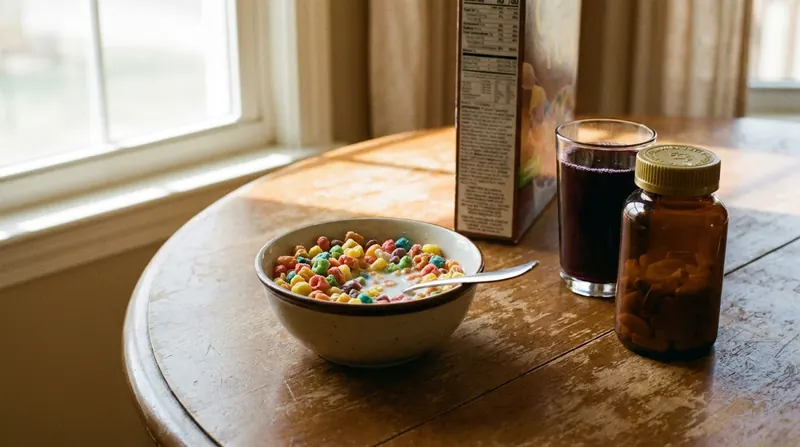
Start with the bowl.
A frosted, honey-coated or chocolate cereal is mostly refined starch and added sugar, and a serving can carry more sugar than a cookie.
No cereal "ages the brain faster than time."
Nobody has measured any such thing, and that phrase was written to be clicked.
What the studies do say is duller, and worth more.
In the Framingham Heart Study, adults who drank more sugary beverages scored lower on tests of memory, and daily fruit juice went the same way. [5]
In a Brazilian study of 10,775 adults followed for eight years, the ones who ate the most ultra-processed food, and the sweet cereal shelf is part of that, lost ground on tests of thinking about a quarter faster than the ones who ate the least. [6]
Both are associations across a population, not a sentence on your bowl.
And a quarter faster than slow is still slow.
The same Framingham families, in a different analysis, scored better on memory tests when their diets carried more choline, [7] which is eggs, milk, meat and beans, and none of which is in a soft chew.
The three drinks.
The "evening drink" in our advertisement is alcohol, and it's the one with the strongest case behind it: in 550 British civil servants followed for thirty years, the more a person drank, the faster their scores fell on a word-fluency test, and light drinkers had no edge over those who didn't drink at all. [8]
The second is sugar in a glass: soda, sweetened tea, the tall flavored coffee from the counter, which is a soft drink with coffee in it.
The Framingham finding above is about sugary drinks, and those are sugary drinks. [5]
The third, in one of our headlines, was coffee.
That was our worst headline.
Plain black coffee and plain tea aren't the drinks any of those studies were about.
Keep your coffee.
These chews have no caffeine, and chewing them doesn't change what's in your cup; they do carry a teaspoon of the sugar hour four counted, and that's where the bowl and the bottle meet.
The three foods.
Processed meat, fried food, and the white-flour shelf: pastries, packaged cakes, white bread.
Our advertisement says "just stop eating these three."
The research says something slower.
In 960 older adults followed for nearly five years, the ones whose meals looked most like the MIND pattern, vegetables, berries, nuts, whole grains, beans, fish and olive oil, held their thinking scores better, and the gap between the top and bottom thirds worked out to about seven and a half years of age. [9]
That's a pattern over years, not a list of three, and it can't be sold in a headline.
Which is exactly why our headline doesn't say it.
Notice that grapes, the fruit behind hour two, are on that shelf by the bunch, with no sugar syrup around them.
Less sugar in the bowl and the glass.
Less alcohol in the evening.
Keep the coffee.
Eat more like the Mediterranean shelf and less like the vending machine.
Every one of those costs nothing, and none of them is in the chew.
The three words, or the three phrases.
There's no such list.
What our advertisement borrowed from is the short, scored mental-status test clinicians have given at the bedside since the 1970s: the date and the place, a few words to hold in mind and give back a minute later, a sum, naming, repeating one sentence, copying a drawing.
It's given in person and read against your age and your schooling by someone trained to do it, and a low score is a reason for a proper look, not a verdict.
Stumbling on a word when you're tired or being timed means nothing on its own.
Nothing begins at a word.
If the worry behind the click is real, that's fifteen minutes with your own clinician, and it costs you nothing from me.
And the advertisement about the things some men take every day.
That one sits closest to real research, and it's the one an advertisement has no business acting on.
Some kinds of daily medicine, including a few sold over the counter for allergies and for the night, are on the lists pharmacists check for people over 65.
Don't stop or change any of it because of an advertisement, ours included. Put everything you take in one bag, this bottle included, take it to the pharmacist, and ask one question: is anything here a poor choice at my age?
A grape extract is a food extract and sits quietly beside most things, but ask about it if you take anything that affects clotting, and mention the sugar if anyone is watching your glucose.
The guide at the foot of this page has that section written out, with the studies.
So if you clicked on the cereal, here's where the cereal went: onto the table next to a bottle that has one thing in common with it, a teaspoon of sugar, where the real answer was always a plainer bowl and a bunch of grapes.
Hour eight · What it isn'tSix Things Two Chewables Won't Do
- It won't give you a trial nobody paid for. Both trials of the extract list authors from the company that makes it, and no independent group has repeated them.
- It won't do for your thinking what its two vitamins can't. Fourteen trials of B vitamins in 27,882 adults who weren't short of them came out about even.
- It won't come without sugar. Four grams, a level teaspoon, in every two chews.
- It won't arrive with a bottle that says "chewable." The label uses a word this page doesn't print, and it's the same soft fruit chew.
- It won't act on any condition a clinician has named. It's a dietary supplement, and its own label carries the sentence that says so.
- It won't come with twenty-four independent reviews. Twenty-three were seeded in one June, and the seller says so in small type.
If that list annoys you, I'd rather you were annoyed now than when the third bottle arrives and you realize you've been chewing a teaspoon of sugar a day without counting it.
Hour nine · The routineIf You Do Buy It: One Bottle, Two Chews After Breakfast, the Receipt Kept, One Notebook
If you're going to spend the money, spend it as a test with a date on it, and for once test a dose that matches its trials.
- Buy one bottle, not the three-pack. Thirty days is the test, and the promise clock is forty-five days from purchase.
- Keep the packing slip or the confirmation email in a drawer. The promise wants proof of purchase, and it covers pharmacy purchases too.
- Chew the two chews at the same time every day, after breakfast, and brush your teeth. The trials ran twelve weeks; a chew on the days you remember tests nothing.
- Ask your clinician for a B12 level if nobody has checked it in a few years. The two vitamins here matter only if you're short, and a blood test is the only way to know.
- Write one line a day in a notebook. Not "sharper" or "foggier." What you were doing at ten, and how it went.
- On day thirty, read the thirty lines. If they read better than the month before, you've found a habit; buy a second bottle, not a three-pack, and remember the trials took twelve weeks. If they don't, you've found out for twenty dollars, and the promise page tells you what happens next.
Look at that list the way I do.
Four of the six things cost nothing.
The bottle is the one you'll pay for, and the notebook is the one that will tell you the truth.

Hour ten · Who it's forWho It Suits, and Who It Doesn't
This is worth a look if:
- You want the one bottle on this desk whose dose matches its trials, and you've read who signed the trials.
- You want a soft chew rather than a capsule, and you don't mind a teaspoon of sugar with it.
- You'd like a day's B6 and B12 along for the ride, and you'll get the blood test that says whether they matter to you.
- You can hold two ideas at once: a well-matched dose with two twelve-week trials behind it, and a maker's name on both bylines.
- You'll run one bottle as a thirty-day test with a notebook, and keep the receipt for the forty-five-day promise.
Give it a miss if:
- You want a trial the maker didn't help write. There isn't one yet.
- You're keeping added sugar to a minimum. This is a teaspoon a day.
- You want something that acts on a condition a clinician has named. This is a dietary supplement.
- You want a bottle whose label matches this page word for word. The label uses a word this page doesn't print.
- You want twenty-four independent opinions. You'll get one, and twenty-three from a launch month.
Hour eleven · Where it's soldFrom a Green Bay Company With a Street Address, Shipping Charged on One Bottle, and a Promise That Covers the Pharmacy Too
The bottle is sold by Nature's Way on its own website, and that's the only place this page links to.

The company is reachable and findable.
Nature's Way Brands, with a street address in Green Bay, Wisconsin, a toll-free number, an email, and a "find near me" button on the listing, because the same bottle sits on pharmacy and grocery shelves.
The label says the chews contain no gluten, wheat, soy, egg, peanut, dairy, gelatin or artificial colors, and the listing says the company tests for contaminants.
The current price is shown on its page, not here.
The day I read it, one bottle cost about what a large pizza costs, which is under seventy cents a day, and that's the cheapest bottle on this desk this year by some distance.
Buy one bottle.
Thirty days is a test.
A three-pack of something you haven't tried is a bet, even at this price, and the trials took twelve weeks to show anything.
Now the two things that matter more than the price.
First, shipping.
The seller ships at no charge on orders over forty-nine dollars, which means a single twenty-dollar bottle pays for shipping unless you add something, or buy it at the pharmacy down the street.
Second, the promise.
Read this twice, because it's broader than most and has one condition.
The policy says: if you're not satisfied with a product bought for personal use from the company or from one of its authorized sellers in the United States, you can return it within forty-five days of the date of purchase for a full refund, excluding shipping charges, with your packing slip or confirmation email as proof of purchase.
The company says it may ask for the product back in its original packaging at your expense, that it watches for abuse, and that clearance items don't qualify.
Match the dose, then read the byline.
Forty-five days, a receipt, a phone call to the number on this page, and possibly the bottle mailed back: that's the whole promise, and it's a fair one that reaches the pharmacy shelf as well as the website.
Keep the receipt, and buy the bottle the promise covers.
Everything in two chewables
| Ingredient | Amount per serving |
|---|---|
| COGNIGRAPE™ grape (Vitis vinifera) fruit extract, standardized | 250 mg |
| Vitamin B6 (as pyridoxine HCl) | 1.7 mg (100 % DV) |
| Vitamin B12 (as cyanocobalamin) | 2.4 mcg (100 % DV) |
| Other ingredients: glucose syrup, cane sugar, purified water, pectin, citric acid, flavorings, sodium citrate, sunflower lecithin, beeswax | — |
Full details on each ingredient are in the guide linked at the bottom of this page.
The ingredient and advertising guide linked at the foot of this page goes through every line on the panel.
What each ingredient is.
What the research does and doesn't show, at what dose and in what form, and who wrote it.
What to be careful about: the sugar if anyone is watching your glucose, and the extract if you take anything that affects clotting.
And which of our own headlines it does and doesn't support.
Print it and take it to the pharmacist if you take anything daily.
It's written for that.
See the current price on the seller's site
Two grape-flavored soft chewables a day of a standardized grape extract at the dose of its two trials, a day's vitamin B6 and B12, and four grams of sugar, from a Green Bay, Wisconsin company.
CHECK AVAILABILITYSold by Nature's Way of Green Bay, Wisconsin, a company with a street address, a toll-free number and an email · Shipping at no charge only on orders over forty-nine dollars: a single bottle pays shipping, or buy it at the pharmacy · A 45-day satisfaction promise with proof of purchase, covering authorized sellers too, refund excluding shipping · The label uses a word for these soft chews that this page doesn't print
QuestionsWhat Readers Ask Me Before Their First Bottle
Questions readers ask
Is this medicine?
No. It's a dietary supplement, a grape extract and two vitamins in a soft fruit chew, sold by a Wisconsin company.
The label carries the standard sentence every American supplement carries, the one that says the FDA hasn't evaluated its claims.
Does it have caffeine?
No. A grape extract, two vitamins, sugar, pectin and flavoring.
Whatever wakes you up is your coffee.
Is the dose really the same as the studies?
Yes. Two chews hold 250 milligrams of the Cognigrape extract, and both twelve-week trials in healthy older adults gave 250 milligrams a day.
It's the only bottle on this desk this year where that's true.
Both trials list authors from the extract's maker, and no independent group has repeated them.
Why does the bottle say a different word from this page?
Because the word on the label is one our advertising rules don't allow on a page about a supplement, so I've called them chewables and soft fruit chews. They're the same thing: pectin, fruit sugar, flavoring and the extract, set into a soft chew.
Nothing else about the product changes.
Which of the lines actually does something?
The extract has two twelve-week trials at this dose in 207 healthy older adults, with the maker on the byline. The two vitamins matter only if a blood test says you're short of them, and the largest review found they do little or nothing for people who aren't.
The sugar does what sugar does.
Will it help my memory?
I can't tell you that, and you should be wary of any page that does. What I can tell you is that the extract's two trials reported better scores on memory and attention tests at this dose, that the maker helped write them, and that nobody has tested these chews themselves.
What the one paying customer I kept describes is concentrating at work and buying seven more bottles.
Can I take it alongside what I already take?
Ask your clinician or pharmacist and take the ingredient guide with you. A grape extract is worth naming if you take anything that affects clotting, and a teaspoon of sugar is worth naming if anyone is watching your glucose.
Two minutes at the pharmacy counter answers it.
Are the reviews real?
They're public on the seller's page and carry its buyer mark. Twenty-three of twenty-four were written in June 2023 by people who received the bottle for the purpose, which the seller discloses and which I've marked beside the three I quote.
The one I quote without that mark paid for hers.
Does it ship to me?
Within the United States, at no charge only on orders over forty-nine dollars; a single bottle pays shipping. The same bottle is sold in pharmacies and grocery stores, and the listing has a button to find one near you.
What if it arrives and I don't like it?
Within forty-five days of purchase, with your packing slip or confirmation email, call the company's number for a refund of the price, excluding shipping. It may ask for the bottle back at your expense.
The promise covers authorized sellers in the United States too, so a pharmacy bottle qualifies.
Your advertisement was about a cereal, or three foods, or three drinks. Where is that on this page?
In hour seven, in full, with the studies. The short version: less sugar in the bowl and the glass, less alcohol in the evening, keep your plain coffee, and eat more like the Mediterranean shelf, grapes included.
None of it is in the chew except the teaspoon of sugar, and the ingredient and advertising guide at the foot goes through every headline we run and says which ones overstate.
Your advertisement said something about three phrases, or spelling three words. Is there a test I can take?
Not on a screen. The words and phrases come from the short mental-status test clinicians give in person, and it's read against your age and schooling by someone trained to do it.
Nothing begins at a word. If the worry behind the click is real, ask your clinician for the proper test.
It's fifteen minutes.
The short versionEverything Above, in Sixty Seconds
- A bottle of sixty soft grape chews from Nature's Way of Green Bay, Wisconsin: 250 milligrams of a standardized grape extract, a day's vitamin B6 and B12, and four grams of added sugar per two chews, no caffeine, thirty days to the bottle, and a word on the label this page doesn't print.
- The extract: exactly the dose of two twelve-week trials in 111 and 96 healthy older adults that reported better memory and attention scores, [1] [2] both with the maker on the byline and neither repeated independently.
- The vitamins: 100 percent of the Daily Value each, [3] which the largest review found does little or nothing for people who aren't short of them. [4] The sugar: a level teaspoon a day.
- Twenty-four reviews, twenty-three seeded in one June and disclosed as such; four quoted, three marked as paid.
- Shipping charged on one bottle; a 45-day satisfaction promise with proof of purchase, refund excluding shipping, covering pharmacies too.
- The cereal, three drinks, three foods and the word test from our own advertisements, in hour seven: less sugar, less alcohol, keep the coffee, more like the Mediterranean shelf, and no test on a screen. None of it is in the chew but the teaspoon.
- The honest use: one bottle, two chews after breakfast for thirty days, teeth brushed, a B12 level from your clinician, the receipt in a drawer, and a notebook.

The last lineWhat a Matched Dose Is Actually Worth
Here's the whole thing in one breath.
One extract at the exact dose of its two trials, in people my age, for twelve weeks, with results on the tests that matter.
The extract's maker on both bylines, and nobody yet who has checked their work.
Two vitamins that matter only if you're short of them, a teaspoon of sugar a day, a launch month of seeded reviews, and a word on the label this page can't print.
And a forty-five-day promise that reaches the pharmacy shelf.
If you're a man who wants the one bottle on this desk whose number matches its study, who has read who wrote the study, and who'll run thirty days with a notebook and the receipt in a drawer, that's worth one bottle.
Not because of the reviews.
Because you'll know exactly what the match is worth, and exactly what it cost in sugar and in asterisks.
Buy one bottle, chew two after breakfast for thirty days, brush your teeth, ask your clinician for a B12 level, keep the receipt, and write one line a day. The notebook is a better judge than I am, and the trials took twelve weeks to be sure.
Check the current price and availability
Two grape-flavored soft chewables a day of a standardized grape extract at the dose of its two trials, a day's vitamin B6 and B12, and four grams of sugar, from a Green Bay, Wisconsin company.
CHECK AVAILABILITYSold by Nature's Way of Green Bay, Wisconsin, a company with a street address, a toll-free number and an email · Shipping at no charge only on orders over forty-nine dollars: a single bottle pays shipping, or buy it at the pharmacy · A 45-day satisfaction promise with proof of purchase, covering authorized sellers too, refund excluding shipping · The label uses a word for these soft chews that this page doesn't print
P.S. If you take one thing from this page, take the two numbers.
Two hundred and fifty milligrams, the dose on the label and the dose in both trials.
Four grams, the sugar that comes with it.
Everything else about this bottle sits between those two.
P.P.S. If the afternoon fog has been with you for a year, and it's there before the coffee too, talk to your own clinician before you buy anything.
Two chews after breakfast are a small habit.
They were never going to answer a question a clinician answers in fifteen minutes and a blood test.
P.P.P.S. And if you do order it, keep the notebook, and keep the receipt.
When the bottle is empty, you'll have thirty lines about your own mornings and fifteen days left on the promise, and both are worth more than the bottle, whichever way the lines turn out.